Baitcaster Setup for Beginners: Brakes, Spool Tension and Fixing Casting Faults
Why baitcaster setup matters on Aussie water
A baitcaster rewards clean technique once the brakes and spool tension match your lure weight, rod length and casting style. Set poorly, it throws birds’ nests on the first cast. Set well, it places soft plastics and hardbodies with control around structure for bream, flathead, mulloway, tailor and kingfish around Sydney and further afield. This guide from Aussie Tackle Box walks through a beginner-friendly setup you can repeat on the bank, the rocks or a small craft without guessing.
Work in metric lure weights printed on the pack (grams), match them to your line class, and treat every new lure as a fresh micro-adjustment rather than a permanent dial setting. Southern summers mean lighter clothing and more wind on open flats; autumn and winter often mean heavier soft plastics and slower retrieves—both change how much brake you need.
Know the three controls before you cast
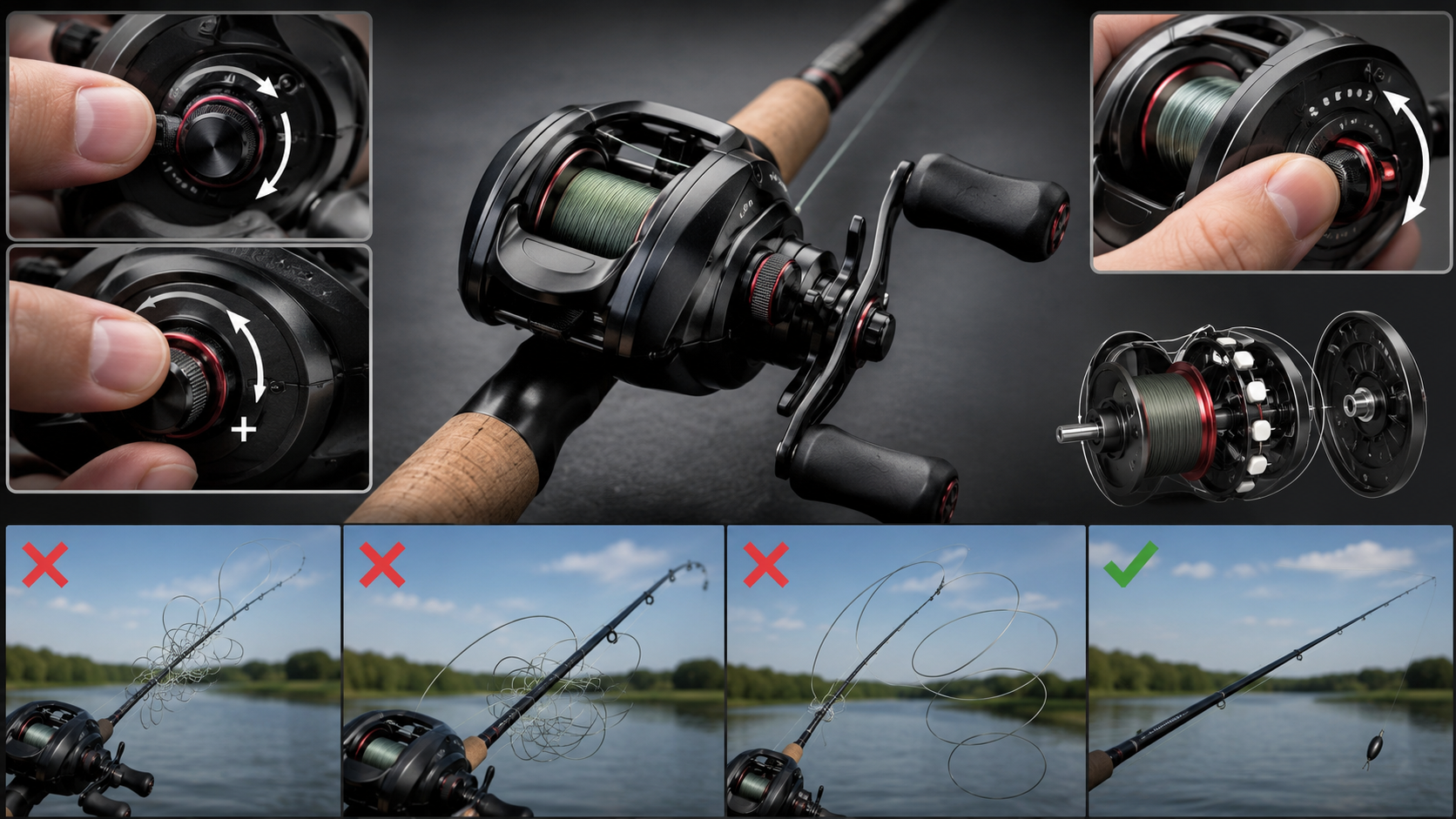
Most modern low-profile baitcasters give you three main adjustments. Learn what each one does so you are not spinning random knobs mid-session.
- Spool tension knob (usually beside the handle): limits how freely the spool spins under the weight of the lure when the rod is pointed slightly down. This is your coarse safety net against overrun.
- Magnetic or centrifugal brakes (external dial and/or internal shoes): slow the spool during the early and mid parts of the cast when speed is highest. Mag dials are quick to tweak on the water; centrifugal shoes are set with the side plate off.
- Drag star: controls how line leaves under load after the fish is on. It is not a casting brake—set it for the line and species, not for casting distance.
Leave the drag firm enough that a solid strike does not free-spool, but still slips before your leader or knots fail on a snag or a heavy mulloway run.
Step-by-step first setup
- Spool quality monofilament or braid suited to the reel’s capacity. Many beginners start with a short mono backing then braid, plus a metre or more of fluorocarbon or mono leader for abrasion around oyster racks and rock.
- Tie on a practice weight or a lure in the middle of the range you actually throw—often around 7–14 g for estuary work, heavier for bar-crossing and kingfish plastics.
- Set the magnetic brake fairly high (for example mid-to-high on a 0–10 dial) or engage most centrifugal shoes if that is your system.
- With the rod at about 45 degrees and the reel in free spool with your thumb lightly on the spool, tighten the spool tension knob until the lure eases down slowly rather than free-falling. It should not slam to the ground; a controlled descent is the goal.
- Make short overhead casts into clear water or grass. If the spool overruns, increase brake or add a touch more tension. If casts feel choked and short with no overrun, ease brake first, then tension in small steps.
- Only chase distance after clean, repeatable casts. Thumb the spool at the end of every cast so the lure lands without a slap of loose coils.
Repeat the tension check whenever you change lure mass by more than a few grams. A 5 g surface walker and a 20 g soft plastic on a jighead will not share the same sweet spot.
Brakes: magnetic, centrifugal and when to favour each
Magnetic brakes are ideal while you are learning because you can turn the external dial without opening the reel. Start conservative in a headwind on Sydney Harbour or coastal lakes, then reduce magnetism as your thumb timing improves. Centrifugal systems shine once you know your usual lure band; fewer shoes mean longer casts with heavier stickbaits for spanish mackerel or big kingfish when conditions are calm.
Hybrid reels combine both. A practical beginner pattern is: centrifugal shoes mostly on for a stable baseline, magnetic dial used for fine control when the breeze lifts or when you drop to lighter bream plastics. Avoid running everything wide open until you can consistently feather the spool with your thumb.
Spool tension without killing distance
Think of spool tension as the handbrake and the brake system as progressive ABS. Too much tension and the spool stalls early, dumping the lure short and teaching bad timing. Too little and the spool races ahead of the line leaving the rod guides. Aim for that slow, even drop test, then rely on brakes and thumb for the rest.
After a few sessions you will notice you can run slightly looser tension because your thumb lands earlier on the spool. That is progress—not a reason to skip the drop test when you swap from a compact vibe for flathead to a larger swim bait.
Fixing common casting faults
Classic backlash or bird’s nest
Stop turning the handle. Do not yank line. Pinch the spool, pull loose loops gently toward the first guide, and work coils free from the top down. Once clear, add a notch of magnetic brake or a whisper of tension and shorten the next cast. Most nests come from late thumbing, sidearm speed casts into wind, or a lure far lighter than the last setup.
Lure dumps at your feet
Brakes or tension are too high, or you are stopping the rod tip abruptly. Ease the mag dial one step, confirm the drop test is not overly tight, and finish the cast with a smooth forward stroke so the tip follows through toward the target.
Line slap and short, noisy casts
Often caused by starting the cast with a slack bow between reel and lure, or by thumbing too early. Engage the reel, point at the target, keep a light thumb touch, then accelerate through a compact arc. With braid, a slightly higher brake setting can tame the faster spool spin beginners struggle to control.
Casts that curve off-target
Check that the rod guides track straight in the cast path and that you are not rolling the wrist open. For tight mangrove edges where mangrove jack live further north, practise pitching with more brake and a shorter stroke rather than full overhead power.
Matching setup to species and tackle
Estuary bream and flathead on 2–7 g plastics favour lighter brake once you are confident, because distance and accuracy around flats drains matter. Mulloway and bigger soft plastics need a stable mid brake so a heavy jighead does not overrun on the punch cast along walls and drop-offs. Tailor and kingfish metals or stickbaits cast harder—keep enough brake to survive a slight mistime, and always thumb the stop as the lure hits the water.
Barra and murray cod country often means heavier cover and larger lures; a firmer baseline brake saves sessions when you are casting all day at timber. Spanish mackerel trolling is a different game, but when you do cast metals from rocks or a kayak, treat wind-on casts as high-risk for backlash and set conservatively.
Rod, line and reel pairing tips
A moderate-fast baitcast rod in a length that suits your platform—often around 1.8–2.1 m for kayaks and small craft, a little longer for bank work—helps load cleanly without forcing wrist flicks that spike spool speed. Match line diameter to the reel’s rated range; overfilling the spool increases backlash risk, while underfilling steals distance. Leave a small gap below the spool rim as the maker recommends.
Leaders should be long enough for abrasion and bite-offs but not so long that the knot constantly slaps through the guides on light tackle. Check knots and the top few metres of line after sessions around rock and oyster, and rinse salt off the reel with fresh water as part of basic gear care.
Practice routine you can do in 20 minutes
- Mark three targets on grass at roughly 10 m, 20 m and 30 m.
- Start with high brake and correct tension; hit the near target ten times without a nest.
- Reduce brake one step; repeat. Stop when nests return, then go back one step.
- Add a light cross-breeze simulation by casting across the wind and note how much dial you need.
- Finish with five pitch casts under an imaginary jetty—short stroke, heavy thumb, higher brake.
That short loop builds muscle memory faster than unhooking birds’ nests on a rising tide. Carry a small spare pack of the lure weights you practise with so on-water changes stay predictable.
Safety, courtesy and local rules
Wear eye protection when practising with hardbodies and metals. Mind other anglers’ casting lanes on crowded Sydney shore spots, and keep hooks away from paths and pets. Recreational fishers must follow bag limits, size limits and any seasonal closures for the waters they fish—rules differ by state and can change, so check the current fisheries information for your location before you keep fish. A tidy baitcaster setup helps you fish accurately and release undersize fish quickly with less tackle mess in the boat or kayak.
Quick checklist before you leave the car park
- Brakes set high enough for the lightest lure in today’s box.
- Spool tension confirmed with a drop test on that lure.
- Thumb ready for every cast; handle not turned until the lure lands.
- Drag set for the line class, not for casting.
- Tools for clearing a nest, spare leader, and fresh water rinse plan after the session.
Master these basics and a baitcaster becomes a precise tool rather than a source of frustration. When you want broader context on choosing rod actions and lengths to pair with your reel, explore the wider tackle guides on Aussie Tackle Box. For local questions about stocked gear chat topics, contact [email protected] or call +61275903570 during Mon–Fri: 09:00 – 17:00 (AEST).

Navigation
See also
FAQ