Barotrauma Explained: Venting vs Descending Devices for Reef Species
What barotrauma looks like on Australian reefs
Barotrauma happens when a fish is brought up quickly from depth and the gases in its swim bladder expand. On Sydney reefs and nearby coastal grounds, this is common with snapper, morwong, nannygai, pearl perch and other bottom species once you are working deeper than about 20–30 m. You may also see it in kingfish and spanish mackerel when they are fought hard from deeper water, though true swim-bladder trauma is most obvious in demersal reef fish.
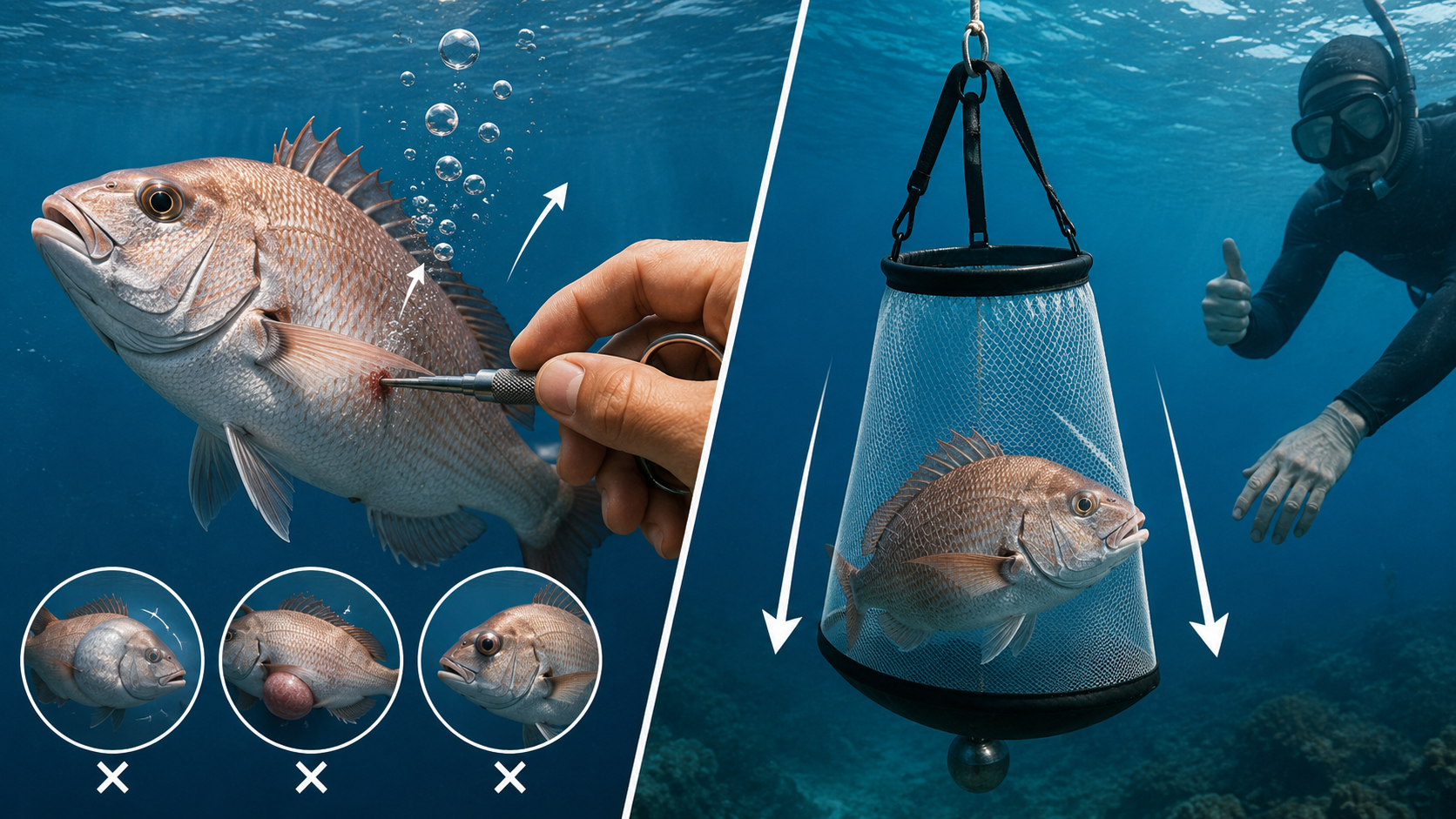
Typical signs include a swollen belly, stomach pushed into the mouth, bulging eyes, tight scales and an inability to swim back down. A floating fish at the surface is not “resting” — it is struggling to recompress. Good release gear and a calm process matter as much as the rod and reel you used to catch it.
Why depth and fight time matter
Pressure roughly doubles every 10 m of depth. A fish hooked in 40–60 m water experiences a large volume change on the way up. Fast electric winches, heavy braid and short fights reduce exhaustion but can increase the severity of expansion if you do not plan the release. Slow, uncontrolled lifts with long pauses in the mid-water column can also leave fish exhausted before they even hit the surface.
In southern hemisphere summer and early autumn, warmer surface water can add stress after a deep fight. In winter, cooler decks and wind chill still demand quick handling. Keep the fish in the water in a knotless net where practical, wet your hands, support the body, and decide your release method before the hooks come out.
Venting: when it is used and how to do it carefully
Venting means releasing excess gas from the swim bladder with a hollow needle so the fish can dive again. It is a last-resort tool, not a default habit. Only vent if the fish is clearly bloated, cannot submerge, and you cannot use a descending device. Poor venting can pierce organs, introduce infection or leave the fish worse off.
If you must vent:
- Use a purpose-made venting tool or a clean, fine-gauge hollow needle — not a random knife point.
- Lay the fish on its side. Find the area behind the pectoral fin, usually a few scale rows up from the midline, where the swollen bladder is closest to the body wall.
- Insert the needle just under the skin at a shallow angle until gas hisses out. Do not drive deep toward the spine or gut cavity.
- Stop as soon as the belly softens. Remove the tool, treat the fish gently, and release head-first into clear water.
Never puncture the stomach if it is everted from the mouth. That tissue is not the swim bladder wall, and stabbing it causes serious injury. Allow everted stomachs to retract naturally after proper recompression where possible.
Descending devices: the preferred option for most reef releases
Descending devices take the fish back down to a depth where pressure recompresses the swim bladder. For many Australian reef species this gives a higher chance of upright swimming and survival than surface release alone. Devices include lip grips with a weighted release, inverted milk-crate style cages, and purpose-built clips that open when they hit bottom tension or a trip mechanism.
Practical set-up tips for small craft and kayaks out of Sydney:
- Keep a dedicated descending rod or a spare outfit rigged with 10–15 kg braid, a strong snap and 0.5–1 kg of lead or a breakaway weight matched to conditions.
- Clip the device to the fish’s jaw or place the fish in the cage while it is still in the water beside the boat.
- Lower to roughly the capture depth, or at least below the worst expansion zone (often 20 m or more for badly bloated fish).
- Trip the release and retrieve the gear smoothly so you do not foul reef.
Mark the outfit clearly in your tackle storage so it is not buried under soft plastics and spare leaders when a fish is waiting. On a kayak, lash the weight and clip to a deck line so one hand stays on the angler and the other controls the fish.
Venting vs descending: a simple decision guide
- Fish upright, swims down hard on release: no tool needed. Minimise air time and move on.
- Mild bloating but still orienting: try a descending device first.
- Severe bloating, stomach out, eyes bulging, cannot dive: descend if you have the gear; vent only if descent is impossible and local rules allow.
- Protected, undersize or out-of-season fish: prioritise speed, wet hands, barbless or single hooks where suitable, and recompression over photos.
Descending keeps internal organs in place and avoids an open wound. Venting is faster when you have no weight system and weather is deteriorating, but skill and hygiene are essential. Many experienced reef anglers on Aussie Tackle Box style loadouts carry both: a venting tool in the terminal tackle tray and a weighted release clip on a spare spool.
Rig and terminal tackle choices that reduce harm
Barotrauma management starts before the bite. Circle hooks in the corner of the jaw often make unhooking quicker for bait fishers. On soft plastics and metal jigs, crush barbs when you expect high numbers of undersize reef fish. Use enough sinker or jig weight to stay vertical without marathon winches through the water column, and match drag so fish are controlled without gear failure at the side of the boat.
Carry long-nose pliers, side cutters for deeply set hooks, a knotless net, and a towel only for grip when a fish must come aboard briefly. Rinse salt off tools at home and dry venting needles so they stay sharp and clean. Store weights and descending clips in a labelled box so sand and loose swivels do not jam the release.
Species notes for common Sydney and coastal catches
Snapper and other reef species show classic swim-bladder expansion from mid-depth gravel and reef. Kingfish caught deep on live baits or jigs may be exhausted more than bloated — prioritise revival in clean current beside the hull before forcing tools. Spanish mackerel are usually a surface and mid-water fish; handle them for meat quality and safety, and use descent mainly when taken deeper than usual. Estuary icons such as bream, flathead, mulloway, tailor, barra, murray cod and mangrove jack rarely need reef-style recompression, but the same gentle-release habits still apply when they are inflated from deeper holes or cold water.
Safety, fisheries rules and good judgement
Check current state fisheries rules for size limits, closures, boat limits and any guidance on release methods before you leave the ramp. Rules change, and Sydney anglers often cross into different waters on longer runs. Keep lifejackets handy when leaning overboard with a descending weight, watch prop position, and never wrap braid around bare hands under load.
For gear questions, local seasonal patterns or help planning a reef kit, contact Aussie Tackle Box on +61275903570 or [email protected]. Hours: Mon–Fri: 09:00 – 17:00 (AEST). Build release tools into every deep-water session the same way you pack spare leaders — the best barotrauma plan is the one already rigged when the first bloated fish comes over the side.
Navigation
See also
FAQ