Reading Sonar: Arches, Thermoclines, Bait Balls and Hard Bottom
Why sonar literacy matters on Aussie water
A fish finder is only as useful as the angler reading it. Around Sydney and along the wider coast, recreational fishos use sonar to separate bare sand from productive ground, track bait that holds tailor and kingfish, and decide whether a drop is worth another cast. This guide from Aussie Tackle Box walks through the main on-screen shapes—fish arches, thermoclines, bait balls and hard bottom—so you can turn pixels into a plan instead of guessing under the hull.
Settings differ by brand, but the physics stay the same: sound pulses leave the transducer, bounce off objects with different density, and return as echoes timed in milliseconds. Soft mud, weed, rock, air-filled swim bladders and dense bait schools all return different strengths. Learn those signatures and you will waste fewer sessions chasing empty water.
Fish arches: what they really show
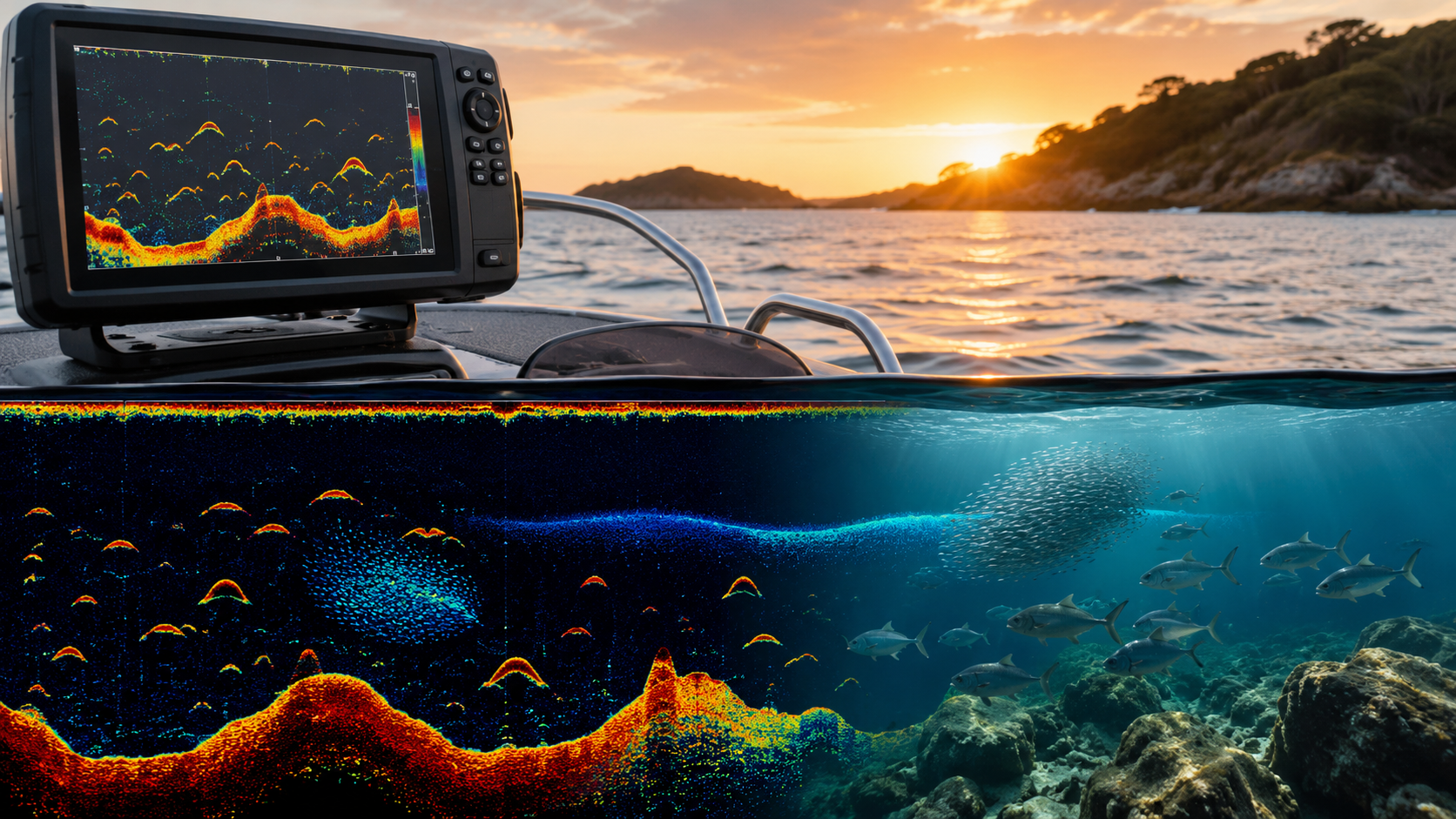
Classic “arches” appear when a fish swims through the cone. The leading edge of the cone first hits the fish at an angle (weaker, deeper-looking return), the middle of the cone hits more squarely (stronger, shallower-looking peak), then the trailing edge fades again. That path draws the familiar curved mark.
- Full arches usually mean the fish passed near the centre of the cone at a steady depth.
- Half arches or dashes often mean the fish clipped the edge of the cone, moved fast, or sat almost still.
- Stacked marks over reef or wrecks can be kingfish, mulloway or mixed reef species holding in the water column—not always one giant fish.
Cone angle and boat speed change the picture. A wide cone paints more water but smears detail; a narrow cone is sharper for deep drops. Slow the boat when you want clean arches. At trolling speed, fish often show as short lines or hooks rather than neat rainbows. On shallow flats for bream and flathead, individual arches are less reliable than bottom hardness and bait scatter, so do not force an offshore mindset into a metre of water.
Sensitivity, frequency and clutter
Turn sensitivity up until you see light clutter, then back it off a touch so true targets stay bold. Higher frequencies (around the upper CHIRP bands many units offer) give finer detail in shallower harbour and bay work. Lower frequencies punch deeper for offshore grounds where spanish mackerel and larger pelagics patrol. If the screen is a snowstorm, check for turbulence under the hull, a dirty face on the transducer, or gain set too high rather than assuming the unit is faulty.
Thermoclines: the invisible shelf fish use
A thermocline is a distinct layer where temperature changes quickly with depth. On sonar it often appears as a faint horizontal band or haze suspended in open water, sometimes with bait or fish hugging its upper or lower edge. In southern hemisphere summer, surface layers warm fast in estuaries and coastal lakes; a cooler band below can concentrate baitfish and the predators that follow them. In winter, mixing can weaken or shift that band, so the same mark may sit deeper or disappear.
When you see a consistent mid-water line that is not bottom and not a single arch, treat it as a temperature boundary worth testing. Drop a lure or soft plastic through it, then work just above and just below. Mulloway and kingfish sometimes suspend on these edges rather than pinning tight to structure. Note the depth on your unit and compare it across a few hundred metres—if the band rises or falls over contour changes, bait often slides with it.
Bait balls and loose forage
Bait schools are among the highest-value marks on an Australian sounder. Dense balls show as dark, cauliflower-shaped or blob-like masses, sometimes with a bright core. Loose forage looks like speckles or a shimmering cloud. Surface-breaking bait may barely paint if it sits in the transducer’s near-field, so watch birds, boils and your down-imaging or side views if fitted.
- Tight balls under birds often signal active tailor, tuna-class speedsters or kingfish working the edges.
- Bait plastered hard on the bottom can mean pressure from above—worth a slow pass for flathead on the sand or mulloway along deeper channels.
- Vertical pillars of bait against a wall or drop-off are prime for timed drops with metals or plastics.
Mark waypoints on the edges, not only the centre. Predators frequently cruise the fringe where they can pin bait against the ball or the bottom. If the school freights quickly, idle ahead on a wide circle rather than running straight through and scattering everything.
Hard bottom, soft bottom and transition lines
Bottom composition is the foundation of species rigs. Hard ground—rock, gravel, compacted shell—returns a thick, bright second echo and a sharp leading edge. Soft mud or silt returns a thinner, fuzzier trace with a weaker second echo. Weed can look “hairy” or double-layered as the acoustic pulse hits the canopy then the substrate.
- Watch the thickness and brightness of the bottom line as you cross contour.
- Note where hard switches to soft; those transition seams hold flathead, bream and ambush feeders.
- On reef edges, look for height changes of even 30–50 cm—small ledges concentrate life.
- Log waypoints in metres and include a short note on hardness so night sessions are easier.
In rivers and impoundments, the same reading skills apply to barra and murray cod country: timber shows as tall spikes or arches rising off the bottom, while clean clay benches look smoother. Adjust expectations for depth and timber density so you do not mistake a snag field for a bait ball.
Practical on-water routine for Sydney sessions
Before you leave the ramp, set a reliable colour palette you can read in glare, confirm the transducer is wet and aligned, and choose a range that keeps the bottom in the lower third of the screen. As you idle out, watch how known sand flats and channel edges paint so you have a local baseline. When you find arches over hard bottom with bait nearby, slow down and work a pattern: soft plastics along the transition, a heavier jighead if current stands the lure up, or a metal if fish are higher in the column.
Keep safety in the same mental checklist as sonar. Maintain a proper lookout, especially when staring at the screen in traffic or near bars, and match your speed to conditions. Fisheries rules vary by state and update with seasons and size limits—verify bag and possession limits for the species you target before you keep fish. Sounder marks do not override closed waters or gear restrictions.
Gear care and realistic expectations
Rinse the transducer face with fresh water after salt sessions, check cable glands for chafe, and avoid painting over the active face with thick antifoul that can dull returns. Small-craft and kayak fit-outs need a clean mounting spot free of turbulence, strakes and bubbles; a slightly imperfect angle can erase arches you would otherwise see. Marine electronics are tools, not guarantees—empty water still looks empty when fish have moved with tide or light.
For broader context on units, mounting and on-water workflows, explore the rest of the marine electronics guidance on Aussie Tackle Box. If you need store hours or a direct contact, use Mon–Fri: 09:00 – 17:00 (AEST), +61275903570 or [email protected]. Read the screen with the same patience you give a tide chart, and arches, thermoclines, bait balls and hard bottom stop being abstract shapes and start becoming repeatable fishing decisions.

Navigation
See also
FAQ